Sheet 1 of 4 · Autonomous robotics · 2026Highest grade boundary
MN-001 · University projectSelf-driving line-following robot
An autonomous racer built end to end, from the soldering iron to race day. The brief was speed without losing the line, and the first version could barely go straight.
Track testReal footage
Final lap10s
From spinning in circles to a clean, consistent ten-second lap on race day.
20+ chassis designs
 CADBuilt
Fusion 360 design timeline
- Chassis
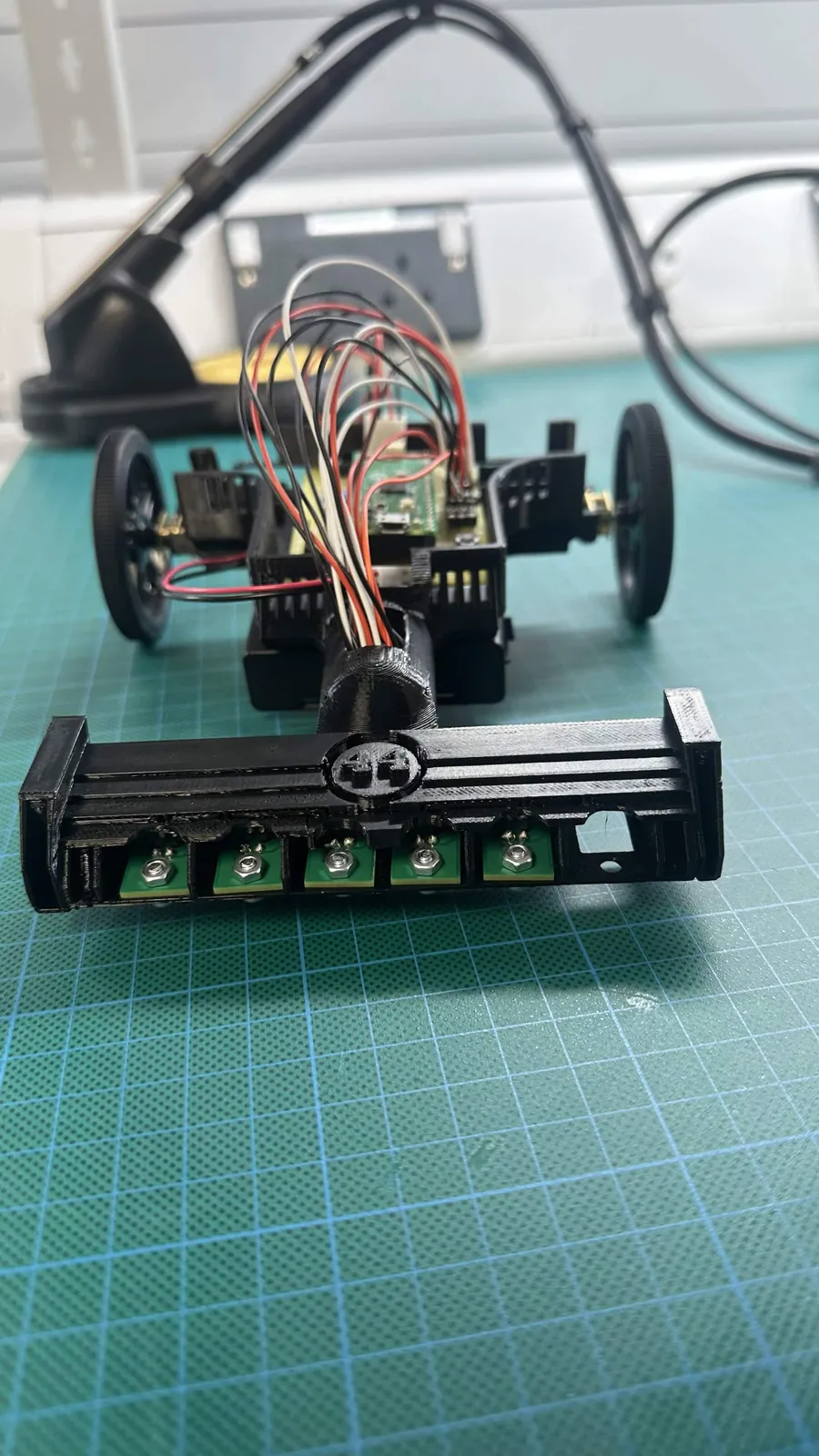
- Designed a custom chassis in Autodesk Fusion 360 that houses every component. Went through more than 20 versions before landing on a lightweight body with a front wing that carries the sensor array.
- Hardware
- Hand-soldered a custom board around a Raspberry Pi Pico, with NPN transistors and rectifier diodes driving the motors.
- Code
- Programmed movement and sensing in MicroPython, using pulse width modulation (PWM) for motor speed. Calibrated the infrared array so surface reflectivity turns into precise steering commands.
- Testing
- The first prototype was unstable and kept leaving the track. I redesigned the motor mounts to lower the centre of gravity, closed the sensor-to-ground gap for a cleaner signal, and kept tuning the code until it ran clean.
- Result
- A consistent ten-second lap, and the highest grade boundary for the project.
20+Chassis iterations
10sLap time
PWMMotor control
Build log · 14 photosDrag or scroll →
- Drawn by
- M. Nasir
- Dwg no.
- MN-001
- Tools
- Fusion 360 · MicroPython · Raspberry Pi Pico · IR array · PWM
- Status
- Raced


